Overview of the USNS
An overview of the USNS assessments and Forefront for Indiana schools. This 30-minute overview covers the assessments, research base, data platform, and how the USNS and Forefront can strengthen schools' MTSS systems.
Helpful Resources for Indiana Schools
To support your review of the USNS and Forefront, we’ve gathered several helpful resources below:
- Access the slide deck from the overview above.
- Download a sample of the K-2 USNS Assessment Manual for Indiana schools.
- Review pricing information. Both the Lite and Basic plans are recommended for USNS implementations.
- Explore the included USNS Essentials Online Course.
- Explore the USNS Essentials PD and USNS Results PD opportunities.
- View other add-on professional learning opportunities on our PD catalog page.
- Find guidance related to accommodations.
- Browse support documents and FAQs about the USNS assessments and Forefront features.
- Learn more about the USNS Project and watch additional student interviews.
Still have questions?
Contact us to request a Q&A session for your team, discuss free demo accounts, and review pilot opportunities.
Video Transcript
Hello and welcome. My name is Tamara Mack, and I work with Forefront Education. In this session, I’ll be introducing the Universal Screeners for Number Sense, often referred to as the USNS.
This overview was created specifically for Indiana schools exploring early numeracy screening options, particularly for kindergarten through second grade. The goal of this overview is to give you a clear understanding of how the assessments work, how they help educators understand student thinking in mathematics, and how schools can use the results to inform instruction and better support student learning.
Recent updates to Indiana’s numeracy legislation have placed an increased focus on ensuring students develop strong foundational mathematics skills in the early grades. Beginning in the 2026-27 school year, schools will administer a math screener to students in kindergarten through second grade to help identify students who may need additional support.
The Universal Screeners for Number Sense were designed to provide educators with meaningful insights into how students are thinking about mathematics while also helping schools identify students who may need additional support. Rather than focusing only on whether students produce correct answers, the assessments help educators understand the strategies and reasoning students use when working with numbers.
I’ll share this contact information again at the end of the presentation, but I want to encourage you to reach out to me or our sales team with any questions. You can contact us by email, phone, or book time directly on my calendar if you’d like to learn more about the USNS, Forefront, or anything covered in today’s overview.
In this session, we’ll cover an introduction to the Universal Screeners for Number Sense, an overview of the assessments and administration, how to understand scoring, and how to interpret results. I’ll provide a brief demonstration of Forefront’s data tools from a teacher’s perspective. We’ll look at how to use the assessment results within MTSS systems, and we’ll conclude with considerations for implementation and an overview of professional learning options.
By the end of this overview, you should have a clear understanding of how the USNS assessments work and how they may support early numeracy efforts in your schools.
Before diving into the assessments themselves, it can be helpful to reflect on two questions.
For the first question, I want you to take a second to reflect on how you want the beginning of the school year to look for your students. When schools think about screening assessments, the focus is often on identifying students who may need additional support. But how you gather that information matters. Do you want students to start the year by going to a computer lab and taking a computer-adaptive test, or do you want them to have a conversation with their teacher? Having a conversation about mathematics with their teacher provides an opportunity for the teacher to get to know their student as a mathematician, and so much more.
Another important question is what teacher learning should occur through the assessment process. You may be focused on what information teachers need to know about their students and their mathematics performance. But just as important, consider what kinds of insights would be most helpful for teachers to have early in the year.
Well-designed assessments can do much more than produce scores. They help educators deepen their understanding of mathematical development and student reasoning. The interview-based structure of the USNS helps teachers see how students approach problems, which often leads to valuable insights that help shape classroom instruction.
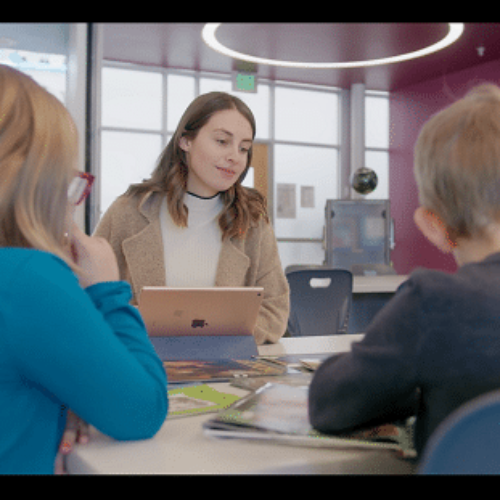
Let’s take a look at an interview together. It’s our beginning-of-year assessment for first grade. We’ll watch this interview for an incoming first grader together.
Sample Interview Excerpt
Teacher: So what I want to start with is just you counting. Let me hear you count.
Student: One, two, three, four, five, six, seven, eight, nine, ten, eleven, twelve, thirteen, fourteen, fifteen, sixteen, seventeen, eighteen, nineteen, twenty, twenty-one, twenty-two, twenty-three, twenty-four, twenty-five, twenty-six.
Teacher: Okay. Let’s try that one more time. I want you to go a little bit slower and a little bit louder. Can you do that?
Student: One, two, three, four, five, six, seven, eight, nine, ten, eleven, twelve, thirteen, fourteen, fifteen, sixteen, seventeen, eighteen, nineteen, twenty, twenty-one, twenty-two, twenty-three...
Teacher: All right. Perfect. One more count. This time start at thirty-eight.
Student: Thirty-eight, thirty-nine, forty, forty-one, forty-two, forty-three.
Teacher: Awesome. Let me hear you count by tens.
Student: Ten, twenty, thirty, forty, fifty, sixty, seventy, eighty, ninety, one hundred.
Teacher: We’re going to read some numbers. What number do I have here?
Student: Eight.
Teacher: And there?
Student: Five.
Teacher: What number is this one?
Student: Twelve.
Teacher: And this one?
Student: Seventeen.
Teacher: And that one?
Student: Twenty.
Teacher: How many counters are there all together?
Student: One, two, three, four, five, six, seven, eight, nine, ten, eleven, twelve, thirteen, fourteen, fifteen.
Teacher: Right here I have four counters. I’m going to cover those up. Over here I have three blue ones. I’m going to put those with the four. How many counters are there?
Student: Five. I know... six, I think.
Teacher: Not sure? How many did I put at first?
Student: Four.
Teacher: And then how many more?
Student: Seven.
Teacher: Seven?
Student: There’s still under there.
Teacher: There’s still under there, that’s right.
Teacher: Now I’ve got eight counters there. What I’m going to do is take two of them back out. How many counters are still under there?
Student: Seven. Six. Seven.
Teacher: Which one is it?
Student: Six. Seven.
Teacher: Seven or six?
Student: Seven.
Teacher: How do you know it’s seven?
Student: Because I’m a smart man.
Teacher: I know you’re a smart man, but let me think about it. We had eight, right?
Student: Wait, six, I think.
Teacher: Okay.
Student: I don’t know. I’m just shooting bulls.
Teacher: Okay. See if you can figure it out so that you’re really certain.
Student: I don’t know.
Teacher: I saw you doing some thinking there. Let’s do it one more time from the beginning, okay? You’ve got eight counters, right? And now I’m going to take two of them back out.
Student: I have no idea. Take away. It is six. I think it’s seven. Six. Seven.
Teacher: You think it’s six?
Student: Seven, seven, seven, seven.
Teacher: All right. We’re going to move on.
Teacher: I’ve got some bears. How many bears are there?
Student: One, two, three, four, five... They look like elephants.
Teacher: They do. Count them carefully.
Student: Five.
Teacher: Five bears. Some of them are hiding. There’s one there. How many are hiding?
Student: Three.
Teacher: So how many bears are there?
Student: Five.
Teacher: And now some of them are hiding. How many do you see?
Student: Three.
Teacher: So how many are hiding?
Student: Two.
Teacher: Here are ten dots. Now I have three more. How many are there all together?
Student: Thirteen.
Teacher: How did you know that was thirteen?
Student: Because ten plus three. Have you not heard of this? There’s a legend about this.
Teacher: There’s a legend? Let me hear the legend.
Student: It’s about when ten is divided with three. This was in the 1920s, I think. And they even saw ten plus eight is thirteen, but one of the guys actually said, “It’s not thirteen. Ten plus eight is not thirteen. It’s three plus ten. Ten plus three.”
Teacher: That’s a really wonderful legend.
Student: I made it up.
Teacher: I kind of got the feeling that you did.
Now that we’ve seen what a fall first grade math assessment can look like, I’d like to encourage you to think back to those two questions that I shared.
What is the experience like for a student taking an interview compared to taking a computer-adaptive test? Computer-adaptive tests typically require students to work independently on a device while answering questions selected by an algorithm. The USNS assessments are very different. Students participate in a short conversation with their teacher and explain their thinking as they solve problems. Because the teacher can hear the student’s reasoning and observe their strategy, the interview provides insight not just into whether a question is answered correctly, but how the student is thinking about numbers and mathematical relationships. It’s also an excellent opportunity for teachers to strengthen their relationships with their students.
Before we look more closely at the assessments themselves, I want to pause for a moment on what we mean by formative assessment.
Assessing formatively means using results to inform planning, instruction, and our interactions with students. The goal is not simply to measure performance, but to learn something useful about how students are thinking so we can respond instructionally.
One idea that often resonates with educators is this: no one can sell a formative assessment. Only you and your teachers can make an assessment formative. This is because formative assessment isn’t something you buy. It’s something you do. It’s a commitment to use evidence of student thinking to guide what happens next in the classroom.
In Indiana, schools that make a K–2 formative assessment selection are also eligible to apply for the formative assessment grant, which is designed to support this work. But to truly follow the spirit of that initiative, the goal isn’t just selecting an assessment. It’s committing to provide teachers with meaningful information and an assessment process they can actually use formatively.
The Universal Screeners for Number Sense were designed with exactly that purpose in mind: to give educators insight into how students are thinking about mathematics and to help guide instructional next steps.
Now to an overview of the assessments themselves.
The Universal Screeners for Number Sense include three assessments each year for each grade level. The fall assessments are entirely interview-based. The midyear and spring assessments include both interview and written tasks.
Interviews are conducted individually with students. They typically take three to six minutes each. Written sections can be administered in small-group or whole-class settings. They usually take between 15 and 30 minutes, depending on the grade level.
The assessments can also be administered in English or Spanish.
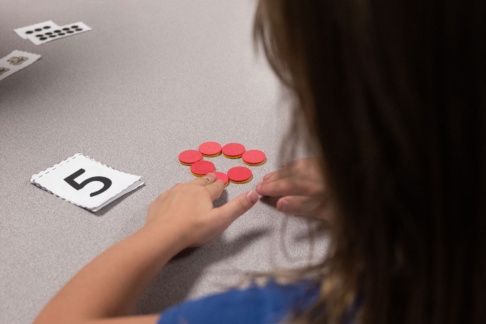
All materials needed to administer the assessments are included in the USNS Assessment Manual. The manual provides interview scripts, scoring rubrics, scoring guidance, and visual supports. Teachers need only a few materials to get ready for the assessments, including printed assessment pages, cards for certain tasks, simple counters, and paper covers.
Interview responses can be recorded either on paper note catchers provided with the USNS Assessment Manual or directly on the Forefront platform. I’ll be highlighting the Forefront platform and our mobile interview tool a little later in this presentation.
The design of the Universal Screeners for Number Sense is grounded in several areas of research.
First, there is a large body of evidence on early numeracy development showing that foundational number sense competencies are strong predictors of later mathematics achievement. The tasks included in the USNS are designed to assess these foundational constructs so educators can identify students who may be at risk for later mathematical difficulty.
Second, the screeners were designed according to established research on universal screening within MTSS systems. Effective screeners are brief, administered to all students, and predictive of later outcomes. The USNS follow these principles so schools can efficiently identify students who may benefit from additional instructional supports.
Third, the assessments have undergone research examining reliability, predictive validity, and classification accuracy. Studies have shown that USNS scores are predictive of later performance on broader mathematics assessments and can help identify students who may need Tier 2 or Tier 3 support.
Finally, the design of the screeners reflects research on how children develop numerical understanding across the elementary grades. Drawing on the work of scholars such as David Geary, Nancy Jordan, and Michelle Mazzocco, they follow established principles of educational measurement outlined in the Standards for Educational and Psychological Testing.
This research helps ensure that the assessments measure meaningful aspects of students’ mathematical thinking.
The next question, of course, is how that information is captured and interpreted once an assessment is administered.
Each task is scored using detailed, question-specific rubrics designed to capture different levels of student understanding. Performance across tasks is used to determine one of four overall performance levels. Schools can review results in several ways, including assessment-referenced views, criterion-referenced views that focus on particular mathematical concepts, and norm-referenced views that compare student performance with national or local benchmarks.
Now that we’ve looked at the structure of the assessments, let’s take a few minutes to see how teachers and leaders typically work with this information inside the Forefront platform.
I’ll highlight a few features of our data solution, Forefront. We’ll start with how data is collected in the platform, briefly touch on ways teachers can view results for an individual student in their class, and then touch on instructional next steps and personalized family letters included with Forefront. Then we’ll return to the slide deck for the quick ten-thousand-foot view of how leaders can review student performance on the USNS assessments.
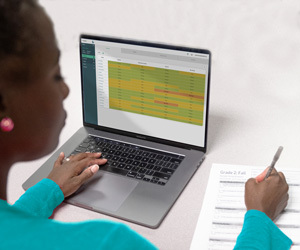
The overview page provides a quick snapshot of assessment activity across the class. Here we’re looking at a first-grade classroom, and we’re reviewing USNS results through the Indiana Academic Standards framework. Teachers can sort and drill into columns to identify needs for Tier 1 instruction, as well as group students needing support with a specific foundational skill.
When reviewing performance information, teachers can also click on a cell to view the body of evidence for that specific learning target.
Forefront can also be used to collect data for more than just the USNS. It can be used to collect data from your core instructional programs, common unit assessments, and other layers of assessment used in your schools.
At the beginning of the school year, teachers can also see how their students performed in the previous grade level. For many educators, this page is a great starting point for identifying patterns across the class and planning instructional next steps.
Next, we’ll look at how teachers capture results in Forefront. Here you’ll see our mobile interview tool. This tool guides teachers step by step through the interview process. Each question appears alongside the scoring rubric, allowing teachers to listen to the student’s explanation and select the appropriate score directly within the platform.
Because the rubric is visible during the interview, teachers can reference scoring guidance while working with the student. This helps ensure scoring consistency across classrooms. Teachers can also gather qualitative observations as they conduct interviews. These observations are made visible when teachers view the body of evidence for specific learning targets.
For the written tasks and to support the collection of progress monitoring data, teachers can also enter results in our spreadsheet view. This view is intended for recording data for pencil-and-paper assessments, the written tasks on the USNS screeners, and reassessing students on the USNS tasks with our parallel probes. This view allows educators to track how students respond to targeted instruction over time.
Another part of the platform is the ability to move directly from assessment data to instructional next steps. Teachers can select a task or concept area and view resources designed to support student learning directly related to that skill.
These research-based instructional resources have been curated from a variety of high-quality sources to provide meaningful instructional responses at a teacher’s fingertips.
Forefront also makes it easy to communicate results with families. Teachers can generate personalized family letters that share student results and suggest ways families can support student learning at home. This example of fall first grade letters shows areas of strength for each student and areas where that student needs additional support. Based on that performance, parents are provided with simple, high-quality ways they can support their child’s learning at home through games, daily number talks, and free online resources.
These letters are available in English and Spanish, and in our Basic plan, they can also be customized by a district before sharing home with families.
Now that we’ve seen how teachers interact with the platform, I’d like to highlight how results from the USNS scores can help strengthen a school and district’s MTSS system.
One thing that makes the USNS especially useful is that scoring is not based simply on whether a student got an item right or wrong. Each task is scored using detailed, question-specific rubrics that are designed to help capture different levels of student understanding. In this report view, you can see how results are organized task by task, giving teachers and leaders a more detailed picture of student thinking and performance across the assessment.
Leaders can identify trends in student performance across specific sites and the district. Teachers can use this view to identify Tier 1 and Tier 2/3 needs for their students and access the next steps for instruction.
Another important point for Indiana schools is that each question in the kindergarten through second-grade USNS assessments has been aligned to the Indiana Academic Standards. That means the assessment is not just generating a general score. It is providing evidence connected to the mathematical ideas and expectations teachers are already working toward in their classrooms. The rubrics are designed to show progress toward proficiency, which helps make results more meaningful for instruction, grade-level collaboration, and broader planning at the school and district level.
Across the assessment, student performance is then combined to determine one of four overall performance levels. That overall level gives schools an efficient way to understand how students are doing at a glance, while still preserving access to the more detailed task-level information underneath.
So this is really a both-and approach. Educators can quickly identify overall patterns, but they can also drill down into specific tasks and concepts to better understand where students may need support or where instruction is already taking hold. From there, schools can use those results to make practical decisions about support and instruction.
As you’ve probably seen already in this session, the USNS assessments can play several key roles within an MTSS system.
First, schools can use the results to identify students who may need Tier 2 or Tier 3 support. The assessments also help identify Tier 1 instructional needs. Within our Basic and Premium plans, schools can also collect results from their core instructional programs, making connections between the USNS and unit assessments.
Forefront’s platform helps teachers and interventionists group students for intervention and monitor progress over time. The instructional next steps help teachers use the USNS results formatively with just-in-time supports to help build students’ conceptual understanding.
Forefront also helps engage families in their students’ math learning with simple ways they can support their child’s learning at home. And last but not least, Forefront connects interventionists and classroom teachers with a shared data platform that improves collaboration across classrooms and intervention groups to support student learning.
This visual model recaptures the main points of the previous slide. It shows how the three assessments work together at the beginning of the year, the middle of the year, and the end of the year to help strengthen Tier 1 instruction. The assessments also help identify students who need targeted supports, use the next steps for instruction to target learning, and then support progress monitoring.
Forefront offers two primary subscription plans for our data platform. The Lite plan includes data trackers, reporting tools, the mobile interview tool, USNS Next Steps resources, and family communication tools. The Basic plan includes everything in the Lite plan, plus additional capabilities such as a handout editor, local assessment trackers for capturing data in your core instructional program, and roster syncing through systems like Clever and ClassLink.
Forefront schools also have access to an asynchronous online course to introduce teachers and leaders to the USNS assessments. This course will be made available in the summer of 2026.
For schools that prefer a synchronous, live learning opportunity, we recommend our USNS Essentials and USNS Results professional development offerings. Our USNS Essentials PD can be delivered to small K–2 teams or, for larger districts, in three separate grade-level sessions. The latter format allows grade-level teams to go deeper into the expectations of their grade level, review sample interviews for their grade level, and gain hands-on scoring practice.
The USNS Results PD helps teachers and leaders understand how to review results in the platform after the fall, or fall and midyear, assessments. Pricing and duration for virtual delivery are provided here. We also offer full-day in-person professional development, which you can explore further in our PD catalog or discuss with us based on your district’s specific needs.
Before we conclude, I want to leave you with one final thought.
Beyond the math, beyond the scores, what we’re really talking about is a movement to better understand our students. Not just how they are performing in mathematics, but how they are thinking about mathematics.
When we take time to listen to students explain their thinking, something powerful happens. Teachers gain insight into how mathematical ideas are developing, and students experience mathematics as a conversation rather than simply a set of answers.
Those moments strengthen relationships between students and teachers. They also create opportunities for teacher learning, helping educators deepen their understanding of how students make sense of numbers and mathematical relationships. In many ways, this work is as much about teacher learning as it is about learning about our students.
And when schools focus on understanding student thinking, you’ll find that assessment time in your district becomes full of opportunities for students to talk with their teachers and share their thinking. Fill your classrooms with math conversations and fill student desks with interesting tasks that reveal as much about student thinking as student performance.
If this approach to assessment resonates with your district’s values, focusing on student thinking, strengthening relationships, and using assessment to inform instruction, we truly welcome the opportunity to partner with you this year as you continue strengthening early numeracy in your schools.
Thank you again for taking the time to watch this overview, and we look forward to connecting with you.