

Attention to early numeracy has been building. The foundations of mathematical thinking necessary for long-term success in mathematics are rightly being recognized as critical, and initiatives for K-2 screening measures are taking root across the country.
Educators, districts, and states are taking a closer look at early math instruction and asking whether all students are developing the foundational skills and number sense they need for success in the classroom. This shift has brought early numeracy assessment into sharper focus, especially in the primary grades.
This work is no longer peripheral. Statewide initiatives in Alabama, Kentucky, West Virginia, Indiana, and other states reflect a growing understanding that foundational mathematics skills call for similar levels of attention, investment, and coherence as literacy. These initiatives often emphasize universal screening, instructional alignment, progress monitoring, and ongoing support for teachers, positioning early math alongside literacy as a core instructional priority rather than a secondary one.
Within this context, RtI and MTSS frameworks are essential. The questions districts are asking today are familiar ones:
-
- What are the core foundational skills necessary for success in mathematics?
- How do we identify students who need support early?
- How do we know universal instruction is effective?
- How do we determine if students are responding to interventions?
- And how will we respond in ways that accelerate learning?
The Role of Math Screeners in RtI and MTSS
Universal screeners are designed to give educators a snapshot of student learning across an entire grade level. Within an RtI or MTSS system, they serve several important purposes.
Screeners help teams understand how well Tier 1 instruction is supporting all students. They help identify students who may need additional instructional support, and they provide a common data source for instructional conversations across classrooms, grade levels, and schools.
When used intentionally, math screeners are not simply a way to sort students into tiers. They are a tool for understanding patterns in student thinking and for asking better instructional questions:
-
- What concepts are students making sense of?
- Where should targeted instruction be focused?
- How might instruction shift in response to the needs of my students?
- How will I monitor student progress?
The Universal Screeners for Number Sense were designed with instructional purpose in mind. The USNS guide teachers in assessing critical skills and help them recognize important milestones in student mathematical development. Teachers observe students as they count, read numbers, and solve problems. This makes assessment data trustworthy, meaningful, and instructionally useful for Tier 1 instruction and throughout the RtI/MTSS framework.
From Screening to Progress Monitoring
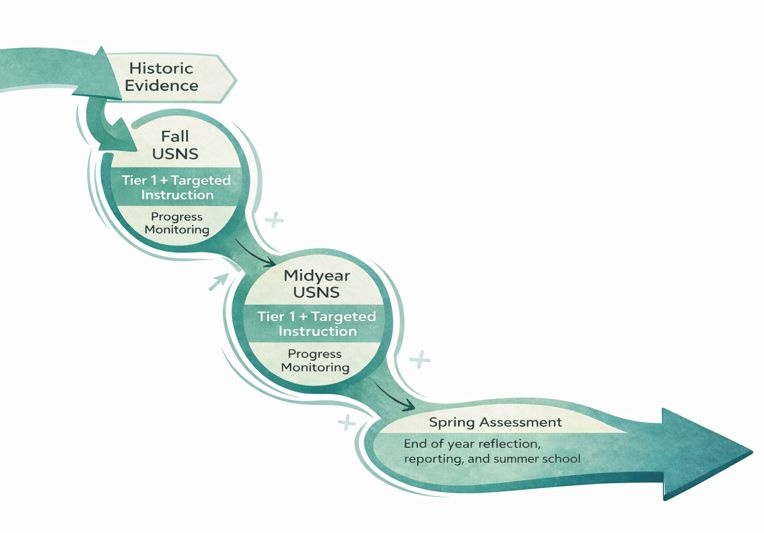
The screening process—that is, the identification of students who are in need of additional support—begins with examining and utilizing historic evidence. This can happen before or after the fall USNS are administered, but it should be considered part of a larger, ongoing process. This work might happen in a PLC or a formal MTSS meeting, but often it is done by individual teachers.
Tier 1
When more than approximately 50% of a class demonstrates unfinished learning on individual tasks or facets of the Number Sense Lens, teachers should consider how those needs will be addressed through whole-class instruction. While this sometimes includes differentiated small group work, it falls short of targeted Tier 2 instruction, where frequent progress monitoring takes place.
Most commonly, Tier 1 (universal) progress monitoring is limited to the results of fall, midyear, and spring screeners.
Tier 2
True progress monitoring begins at Tier 2. Tier 2 of an MTSS system begins with a plan.
A Tier 2 plan includes:
-
- Identification of a specific learning target (for example, counting fluently to 22)
- A plan for how that goal will be addressed, including when instruction will take place and who is responsible (for example, daily practice, parent involvement, or Tier 1 instructional routines)
- A clear plan for how and when progress will be monitored (for example, listening to the student count every Friday until the goal is met)
Without a documented plan, there is no Tier 2. The execution of the plan is Tier 2.
Using the USNS, Tier 2 progress monitoring relies on parallel tasks provided by Forefront to reassess specific skills. For example, if Student A does not read the selected numbers under 100 during the fall screening, the teacher identifies that need and sets a goal. Student A then receives targeted instruction, and progress is monitored using a similar, but not identical, set of numbers. Results are entered into Forefront for record keeping and reporting.
The progress monitoring system provided is criterion-referenced. That is, performance goals are set relative to curricular expectations, not norms. Anticipated growth metrics and a technical manual are not yet available.
New Progress Monitoring Supports for USNS
To support districts in moving smoothly from universal screening into instructional follow-up, Forefront provides parallel tasks for the entire K–5 USNS series. You can download these parallel task to support progress monitoring from the USNS download page linked here.
The USNS Progress Monitoring resource is an open-source document that includes alternative and parallel prompts for USNS tasks. These prompts allow educators to reassess the same underlying skills without repeating identical tasks. Directions and scoring criteria remain consistent with the original USNS prompts, creating a coherent framework across grades K-5.
As of early 2026, midyear prompts are available to the public, with additional guides for fall and spring assessments planned for later in the 2026 calendar year.
In addition to these open resources, Forefront school district clients have access to in-platform tools that support progress monitoring. These tools allow educators to automatically generate written progress monitoring probes that align directly to USNS midyear and spring assessments. This streamlines preparation and administration and keeps the focus on student thinking. More information about using progress monitoring probe handouts within the Forefront platform is available here.
Bringing It Together: Screening and Progress Monitoring in Practice
To support districts and educators navigating this work, join us for a virtual session focused on using universal screening and progress monitoring together within an RtI or MTSS framework. In this session, we will explore how early numeracy screening functions within MTSS/RtI systems. The session will also explore how USNS supports both screening and progress monitoring, and how open resources and platform tools can be used together to monitor growth in student thinking over time.
The focus will be on practical implementation and instructional decision-making. Learn more and register.
Looking Ahead
The growing emphasis on early numeracy reflects a broader shift in how educators think about foundational learning. Just as literacy initiatives prompted deeper conversations about instruction, assessment, and intervention, early numeracy efforts are encouraging similar reflection in mathematics.
When math screeners, progress monitoring, and instruction are intentionally aligned, assessment becomes a tool for learning rather than a compliance task. Within an RtI or MTSS system, this alignment helps educators respond earlier, teach more intentionally, and better support students as they develop strong mathematical foundations.
More from our blog
See all posts
Fractions are hard. They mark a pivotal shift in students’ math journeys, where number sense deepens…

What does it really mean to “do math”? Depending on whom you ask, the answer varies…
Data tells stories—stories of growth, challenge, persistence, and achievement. As the 2024-25 school year concludes, educators…

Diversity, equity, inclusion, and accessibility efforts are once again in the news—this time under attack. While…

For educators, "data is actionable" is overused to the point of losing meaning. In a recent…

One professional development priority for teachers is data literacy. In today’s education landscape, data literacy is…