
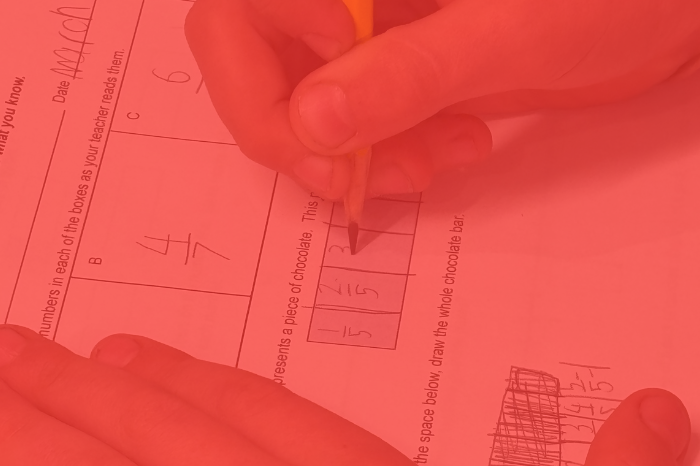
Fractions are hard. They mark a pivotal shift in students’ math journeys, where number sense deepens and complexity increases. Unlike whole numbers:
-
- Fractions can represent the same value in different forms. For example, ¾ is equivalent to 6/8 and 1 ½ is equivalent to 3/2.
- The concept of “whole” can vary from the combined pieces in a set to a single item.
- They involve unintuitive and abstract ideas that can challenge not only students, but classroom teachers, too.
Not only are fractions hard, the research base consistently shows that early fraction proficiency is a critical foundation for future mathematical success, particularly in algebra and advanced mathematical concepts. Siegler et al. (2012) found that elementary school students’ fraction knowledge uniquely predicts algebra and overall mathematics achievement 5 to 6 years later, even after controlling for other cognitive factors. Melissa DeWolf et al. (2016) similarly suggested that relational reasoning with fractions can enhance algebraic reasoning capabilities.
This presents elementary and middle school teachers with a difficult problem: fractions are hard concepts to teach, but they are also critical to students’ future success. How can educators rise to this challenge?
Alabama Numeracy Act (ANA)
In 2022, the Alabama Numeracy Act (ANA) was officially signed into law. The goal of the Act is to improve math proficiency in K-5 public schools by ensuring grade-level skills and providing resources like math coaches and interventions. The initiative focuses heavily on foundational concepts taught in elementary school classrooms and mandates screeners, diagnostic tools, and high-quality instructional materials. It also provides professional learning and resources for instructional coaches to help students succeed.
The ANA was cited as a major reason why Alabama’s 2024 National Assessment of Educational Progress (NAEP), known as “The Nation’s Report Card”, showed the only increase in 4th grade math scores nationwide. Alabama was the only state to show growth in 4th grade math performance from pre-pandemic (2019) levels.
ANA and Fractional Reasoning
“Fractional reasoning” is not explicitly defined in the Alabama Numeracy Act; however, the Act describes that students in 4th and 5th grade should be able to:
-
- Represent unit fractions with area and length models;
- Represent equivalent fractions using pictorial models;
- Compare and order fractions and decimals;
- Add and subtract fractions with like denominators; and
- Multiply whole numbers and fractions.
To understand students’ performance on these expectations, the Act mandates the use of “Fractional Reasoning Screeners.” Incoming 4th and 5th grade students must be assessed a minimum of two times a year to identify students needing support in fractional reasoning.
At the time of the Act’s passing, however, no Fractional Reasoning Screeners existed. No company, publisher, or non-profit had created any assessment or instructional resources focused on reasoning with fractions. As one of Alabama’s approved early numeracy screeners, the Universal Screeners for Number Sense (USNS), were hosted and developed by Forefront Education, we initiated a two-year process to develop, test, pilot, and refine the Fractional Reasoning Screeners.
Forefront’s Fractional Reasoning Screeners
Forefront’s Fractional Reasoning Screeners (FRS) are pencil-and-paper assessments designed to make students’ fraction thinking visible. They do not just check whether students can get answers; they reveal how students understand fractions across shapes, sets, number lines, words and symbols, comparison/equivalence, and computation. They offer a snapshot of students’ conceptual understanding and the places where they are still using whole-number thinking.
Educators use the screeners formatively to understand where students are and what support they need. Because the tasks invite students to show their reasoning, teachers can see strengths, misconceptions, and developmental progressions ranging from partitioning to unit fractions to equivalence and operations. The goal is to help teachers target instruction and support students in building lasting fractional reasoning, not just procedural skills.
The FRS are being implemented statewide in Alabama for the first time this fall. The results should not be surprising to teachers, administrators, and math instructional leadership: students are struggling with these tasks. But unlike high-stakes tests, and unlike benchmark or interim assessments designed to predict those tests, the FRS are formative. They help provide teachers with valuable insights into how students are thinking about fractions.
This is different from assessments that focus on whether students get the right answer. On the FRS, a student can get the correct answer, but if they rely on a procedure they do not understand, they are not considered proficient. The goal is to assess conceptualization, not answer-getting.
2025-26 Results (So Far)
As an assessment data company, Forefront provides tools to help collect and visualize results. For the FRS, we also have a “Global Cohort.” Our Global Cohorts are de-identified, aggregated datasets of student assessment results collected across many schools, districts, and states. They are used to create national norms for our pre-configured assessments. Currently, the FRS dataset comprises primarily Alabama 4th and 5th grade classrooms. Here are a few key takeaways as of early December 2025:
-
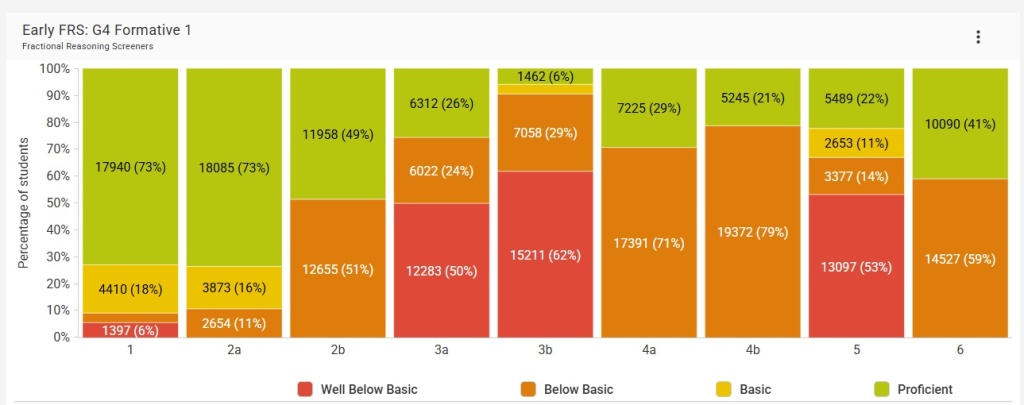
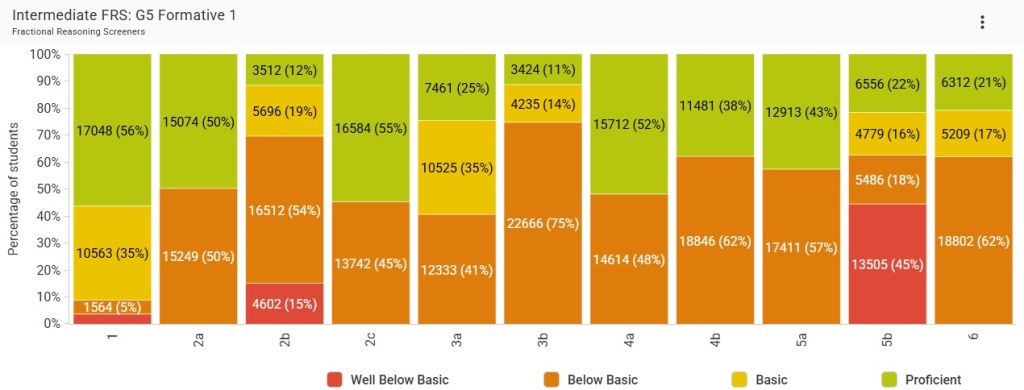
- Only 10% of students (2,527 total) were overall “proficient” with the fourth grade Formative 1 assessment, and only 13% (4,036) were proficient on fifth grade Formative 1. Most students struggled.
- Over 70% of fourth graders did well with writing fractions or shading portions of a square or circle.
- In fifth grade, the majority of students could write fractions, shade rectangles, or draw a model to represent ⅝ of a set.
- In fourth grade, the biggest difficulty was using number lines. Only 6% could correctly place ⅔, ¼, 3/1, and 4/3.
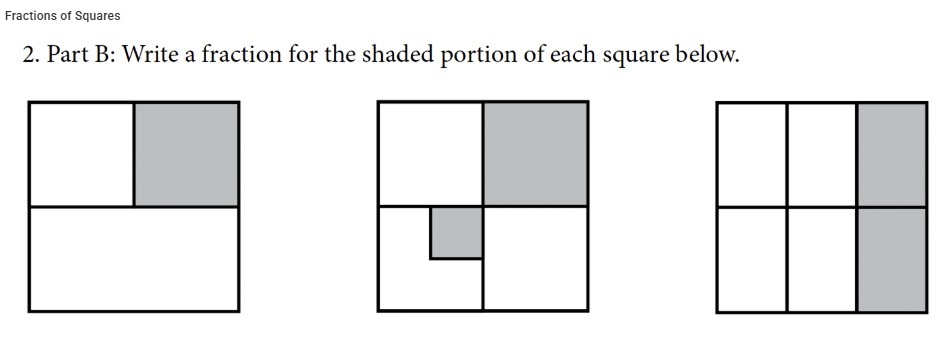
- In fifth grade, only 11% could place 5/8 and 1¼ on a number line, and only 12% could interpret non-standard pictorial representations (see below image).
FRS Global Cohort Results
For your reference, see screenshots of Question Analysis reports for the Early FRS assessment used in fourth grade and the Intermediate FRS assessment used in fifth grade below. These results are from December 8, 2025.
FRS Next Steps for Instruction
As the FRS are purely formative, “seeing red” means there is work to be done. It should be an indicator of a starting place for teachers, not a stoplight. Forefront Education partnered with a variety of leaders in elementary math education to develop instructional responses that help teachers respond to their students’ results, including Pam Harris, Berkeley Everett, Graham Fletcher, and Essential Math Concepts’ Peter Sickler. Forefront clients can access the FRS Next Steps for Instruction as outlined in this support article.
We’ve also been hosting a series of webinars to help teachers understand how to dive into these resources and adopt these instructional strategies in their classrooms:
Introduction to Fractional Reasoning, co-hosted with Pam Harris of MathIsFigureOutAble, is available on-demand here. The webinar helps educators understand how fraction performance differs from fraction reasoning, and provides a practical introduction to the “why” behind the Fractional Reasoning Screeners.
FRS Next Steps for Instruction - Number Lines, co-hosted with Peter Sickler of Essential Math Concepts, models the three number line talk resources in the FRS Next Steps resources. Peter demonstrates how to integrate these number line talks into instructional routines to build students’ understanding of number lines as measurement models. Watch the webinar on-demand here.
FRS Next Steps for Instruction - Making Connections, co-hosted with Berkeley Everett, an elementary math coach at UCLA, models the “Same and Different” slides in the FRS Next Steps resources. These highly accessible digital slides provide a quick way to introduce number talks about fractions into your classroom. Learn more and watch the webinar on-demand here.
And upcoming, join Forefront Education and Graham Fletcher for an overview of the 3-Act Tasks that teachers can incorporate into their instructional routines. Sign up for the event here.
Conclusion
If you are seeing “red” in your FRS Formative 1 results, you are not alone. Fourth and fifth-grade students are struggling with these tasks. They are difficult. And if we are honest, some of these tasks are not just difficult for students, they are challenging for us as teachers, too.
But these assessments are not labels, and they are not tools for filtering or ranking students. They are formative assessments: windows into how students are thinking about and understanding fractions. With these insights, and with the instructional responses included in the FRS Next Steps resources, we have an incredible opportunity to impact a generation of students. That successful jump in mathematical understanding, fractions, can become the launching point for middle school mathematics and high school algebra.
Citations:
Siegler, R. S., Duncan, G. J., Davis-Kean, P. E., Duckworth, K., Claessens, A., Engel, M., Susperreguy, M. I., & Chen, M. (2012). Early Predictors of High School Mathematics Achievement. Psychological Science, 23(7), 691–697. https://doi.org/10.1177/0956797612440101
DeWolf, M., Bassok, M., & Holyoak, K. J. (2016). A set for relational reasoning: Facilitation of algebraic modeling by a fraction task. Journal of Experimental Child Psychology, 152, 351–366. https://doi.org/10.1016/j.jecp.2016.06.016
More from our blog
See all posts
Attention to early numeracy has been building. The foundations of mathematical thinking necessary for long-term success…

What does it really mean to “do math”? Depending on whom you ask, the answer varies…
Data tells stories—stories of growth, challenge, persistence, and achievement. As the 2024-25 school year concludes, educators…

Diversity, equity, inclusion, and accessibility efforts are once again in the news—this time under attack. While…
For educators, "data is actionable" is overused to the point of losing meaning. In a recent…

One professional development priority for teachers is data literacy. In today’s education landscape, data literacy is…